
Trace Gwinnett Owners Backward
Build the chain from real transfers. Never start with a guessed list of names. Each step belongs in order, with the prior owner, instrument type, and book or page tied to the same parcel in a running table.
| Transfer date | Grantor to grantee | Deed type | Book/page |
|---|---|---|---|
| Newest matching record | Prior holder to current grantee | Read the instrument | Save exact reference |
| Next earlier record | Earlier holder to prior grantee | Read the instrument | Save exact reference |
| Continue backward | Repeat named link | Watch estate or quitclaim steps | Keep legal description aligned |
GSCCCA offers two routes: name and book/page. A plat or prior deed reference inside the recorded image often proves more reliable than a street address, especially where rural land-lot descriptions or later renumbering are involved.
Mark Gwinnett's 1871 Break
Gwinnett real-estate records survive only from September 26, 1871. Earlier records burned in a courthouse fire. The Clerk publishes that start date as a hard warning against claiming any seamless county deed chain back to 1818.
Coverage limit. The clerk-stated run begins in 1871. Earlier owners need archival sources and may remain inferred rather than proved.
At the fire boundary, the deed chain ends. Shift instead to land-lot evidence, tax digests, plats and warrants, and historical collections, labeling each bridge by its source.
Review Gwinnett Deed Sources
The county's deeds and land-records page covers surviving record classes and the records' start date.
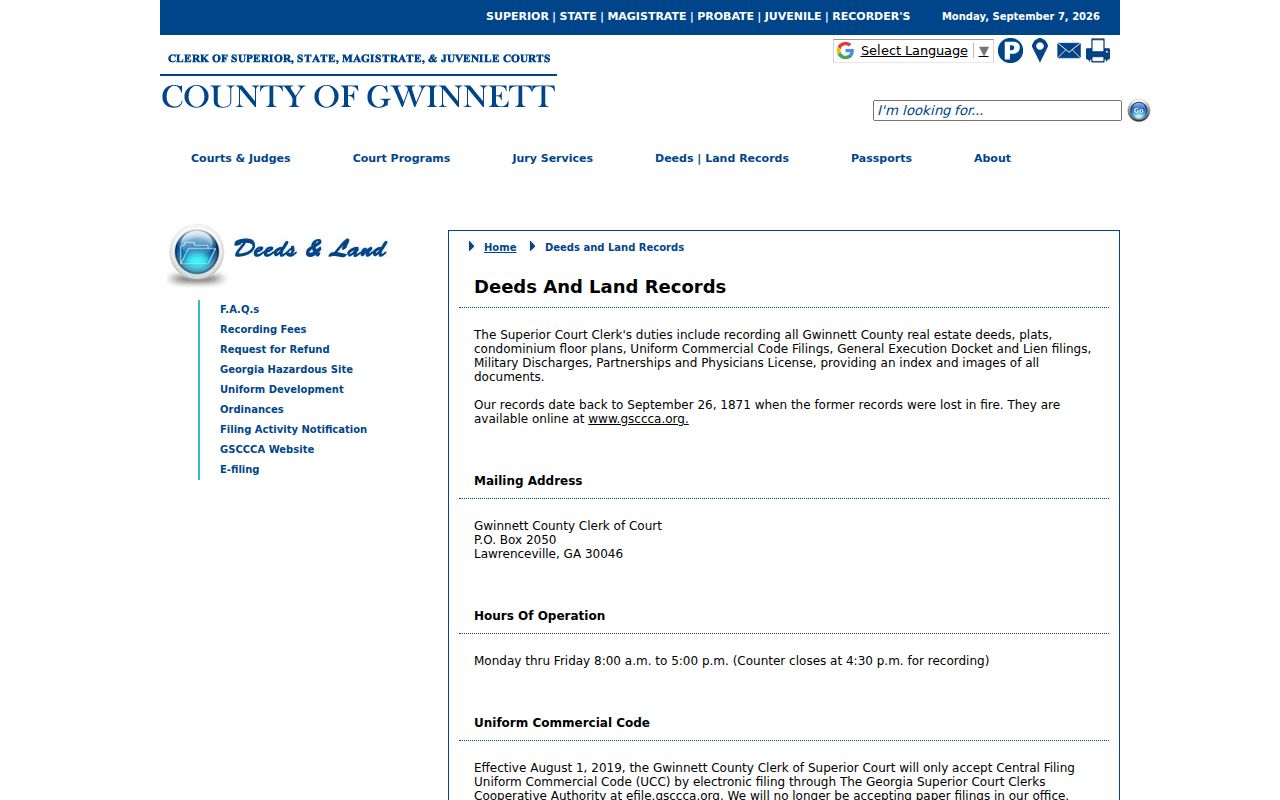
The office source anchors the time-depth search before later archive clues are added.
Reconstruct Gwinnett Deed Links
Search the current grantee first. Open the newest matching conveyance. Its grantor is the prior owner. Next, search that grantor as grantee in an earlier instrument, matching the parcel through legal description, acreage, subdivision lot, land lot, and plat references. Assignments, security deeds, releases, and liens run on separate encumbrance trails, so keep their parties out of the chain unless a conveyance truly transferred the relevant interest.
Go Back Through Gwinnett Deeds
Keep one worksheet row per conveyance and one citation per conclusion.
- Find the newest deed with the current holder as grantee.
- Read the grantor, deed date, recording date, and prior-record references.
- Search that grantor as an earlier grantee and match the same land.
- Repeat until the evidence stops, then move to books or archives.
- Grantor
- The party conveying an interest.
- Grantee
- The party receiving that interest.
- Chain of title
- The ordered sequence of conveyances for the same land.
- Reverse index
- An index organized to help follow parties backward.
- Quitclaim
- A deed conveying whatever interest the grantor has, without a warranty of title.
Bridge Historic Gwinnett Owners
Georgia Archives holds tax digests from 1872 through 2002. Coverage is nearly complete. Entries run by militia district, roughly alphabetical. Executor, agent, widow, heirs, and defaulter labels can explain name changes, but every tax listing still needs reconciling with land-lot and deed evidence.
Colonial plats and warrants sometimes name grantees and adjoining owners. Treat them as geographic bridges. They cannot substitute for a missing deed.
The Archives notes one trap. African American and Freedmen entries may appear near the end of a militia district instead of the main alphabetical run. Search the full district. Tax material from 1870 through 1890 is also indexed and scanned through a commercial genealogy collection, while the Archives Vault index can point to original volumes without supplying images.
Never attach a nineteenth-century tax name to a modern PIN by surname alone. Preserve the details. Keep the militia district, land lot, acreage, nearby owners, road or water features, and every deed or plat citation together. When they do not align, describe the tax entry as a possible lead. That caution protects the chain from a confident but unsupported jump across the fire-loss gap.
Search Gwinnett Local Archives
The Gwinnett Historical Society archives keep deep local holdings. Their collections include historic deeds, maps, tax and court books, family and property files, and city binder indexes.
Visits run by appointment. These holdings can bridge a name or place where the online chain stops, though any finding should keep its collection citation.
Resolve Gwinnett Estate Transfers
Death breaks the neat grantor-to-grantee pattern. Probate supplies the missing link. Search Gwinnett Probate for wills, letters, administration, year's support, and court authority, then return to the deed index for the executor's or administrator's deed, since authority to act is not itself the conveyance.
Access varies. Selected estate files appear online, while other public files are requested by email or in person. Requests exceeding ten files per day need advance notice. General estate indexes reach through surname-grouped nineteenth-century volumes and later year ranges; physical book requests may take up to two business days, and public copies are charged by the page.
Log each event separately. Decedent, fiduciary, court file, order date, deed grantor, deed grantee, and recording date are distinct facts. Link them only by evidence. The tax roll may still carry the decedent or estate name long after authority was issued. Only the later deed with its matching land description proves the property interest actually moved.
Label Gwinnett Ownership Limits
Any chain breaks at its weakest link. Separate owners proved by matching deeds from people merely inferred through tax, probate, newspaper, or archive records. A directory occupant is not necessarily an owner.
Lawful use. Former-owner research supports house history, estate work, and land diligence. Never use it to track, target, or harass a living person.
Need today's name instead? For the present owner of record rather than the chain back, use the Gwinnett current-owner record, and let historical gaps stay visible instead of filling them with guesses.